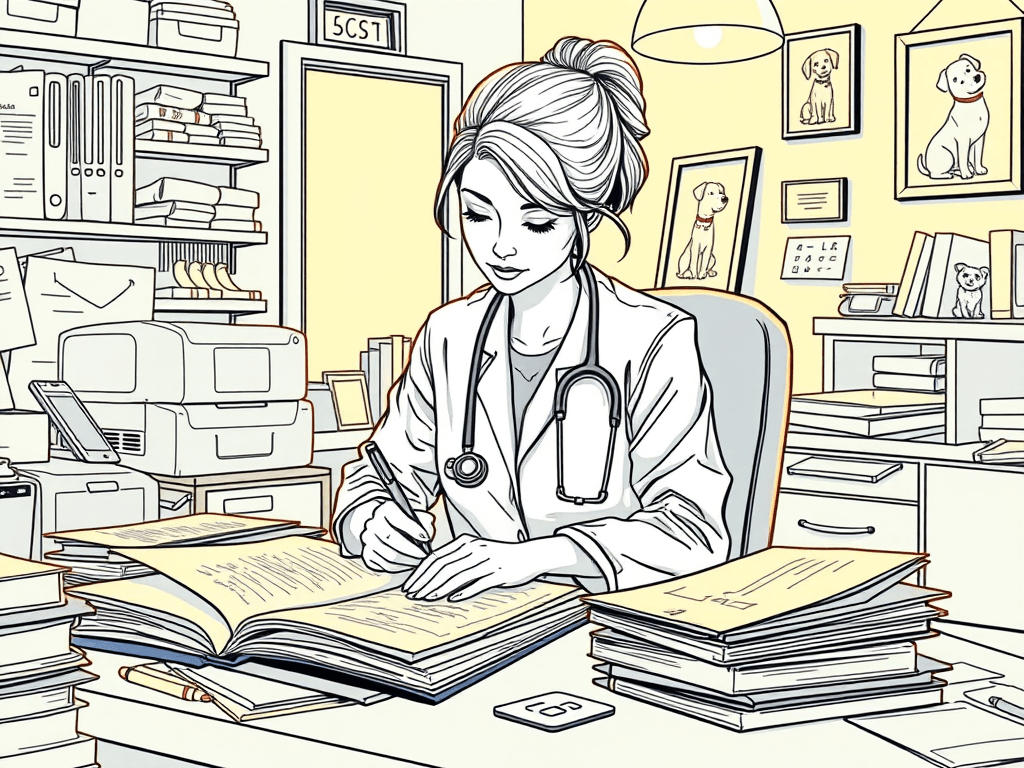
Why you should write them at the time and some tips to help you do this.
A common factor in vets who burnout is time spent at work. So many vets stay behind late after work. This is especially true for New Graduates who are already having to swim in far deeper waters than the rest of us each day. A really common reason for this is to ‘catch up on notes’. Essentially to finish writing the histories for each patient that vet has come across to have a record of everything that has been done.
Why are notes important?
Notes are critically important for vets and rightly take up a lot of our time. It is important to have clear and thorough notes covering what has been done. The aim of note taking is as follows:
- To allow any vet to understand what has been done and how the patient has responded so that if you are no longer present the animal’s care can be continued seamlessly without impacts on said animal.
- To track the patients status over the course of their visits, e.g. heart sounds. This allows for responsive personalised care e.g. a change in heart murmur grade.
- To provide honest information to insurance companies about conditions.
- To protect the practicing vets from complaints. If an accusation of insufficient care is thrown you will be grateful for notes that show the thorough and amazing job you have done, or notes that show a resistant client despite lots of discussion and warnings. If you do not have those notes then you will be unable to defend yourself and the complaint will go a lot further.
- This is why even phone call discussions need to be tracked, from everyone in the team if it involves passing on information to the client relating to the patient’s health. Appointments don’t need to be marked unless it is to highlight that the client has repeatedly missed recommended ones.
Writing this, two thoughts come to mind. One is that notes need to cover a lot of ground, gone are the days of one line summaries. The other is that the notes are as important as everything else you do that day. They are part of the fabric of the work we do and yet they often are the first thing to be left when the day gets busy.
Why we should not push notes when we are pushed.
It is easy to delay writing notes to a quieter time. You want to write them well to make sure they are clear and accurate. It is an obvious thing to drop to catch up on time when you are running late. I want to urge you to try and stop doing this. Often writing notes only really adds a couple of minutes per consult and I want you to prioritise doing them at the time. Here’s why:
- You will forget things! Even the best minds will drop something when seeing up to 35 consults a day. If you then leave notes on some of them till the end of the day, amongst all the other things you need to remember, little bits will be forgotten and that one day might be a problem. I’ve missed notes on an entire consult before because I thought I would write them later.
- If the notes are not up to date and something happens later in the day, another vet will not know what you did. This happens more often than you would think.
- You are giving a false impression of your day and this leads to being overbooked and burning out. If you are running late it is normally not your fault. If an animal needs extra time than the allocated consultation, we give it. We all want to do a good job and so do our best to go as fast as we can. In an attempt to be efficient and show respect to our clients we push what we can until later so we can see them closer to their allotted consultation time. This means that the day goes smoother than it should and the team thinks everything is fine when actually you still have an hour’s worth of work in front of you. How can they help if you don’t look like you need it? Consultations can be picked up, someone else can take your bloods. Stand strong in your day and your time keeping, get help if you are unable to finish your notes and stay on time. If you don’t, the problem will compound. If you don’t take the time you actually need to do a full consultation consistently you will be overbooked the next day for similar cases and then feel pressure to continue the cycle. There is no shame in taking the time you need, you are still a good and productive vet. Let the speed come naturally, don’t force it and don’t pretend you are running at a pace you are not. This job is a marathon, don’t sprint.
- You are giving your time away for free. You are employed and paid to be a vet. Being a vet involves clinical notes. Staying late to finish notes is giving your time for free. Stop it.
Tips for speeding up notes.
Of course writing notes are important and you want them to be thorough. You need time to do them as I have said. But you also want them to be quick to allow you to fold them into your day. Here are some tips I have developed, I would love to hear any others you have:
- Templates are king, save a range of templates for the routine consults. I have a DM to myself on the practice messaging app with a range of consult templates. I then copy and paste the template and then edit it to reflect the patient. Of course you have to make sure you do otherwise you may record an incorrect finding. I find it saves a lot of time.
- Use a short hand. Embrace the vet acronyms. TTCO LVM (tried to call owner, left voicemail). Nad (no abnormalities detected). STO (spoke to owner). WNL (within normal limits). My personal favourites: Dude normally, (drinking/urinating/defaecating/eating normally) CBA (cat bite abscess). Don’t make them up though, nothing is more frustrating then trying to decode notes when a vet has invented their own language.
- Try and write as efficiently as possible. I know, I know. The cheek of me saying that! But seriously, every time you write notes aim to parse to the most efficient summary. Each time you will get better and better and other vets will thank you for it. I joke that one line histories are now a thing of the past but it’s amazing how much detail you can get from that one line from our older colleagues! The only reason I don’t recommend summarising to that extent is that you often miss recording the normal findings of clinical exams, e.g. that the lungs sounded clear. It used to be taken as read that no mention meant ‘normal’ but unfortunately insurance companies and investigating bodies will no longer accept this. It is much harder to say, ‘I didn’t mention it as it was normal,’ compared to, ‘I wrote that it was normal at the time and so it was’.
- Write them at the time with the time pressure on you. If you wait till the end of the day you will be relaxed and simply write slower. Also, if you don’t force yourself to do it you will not get used to doing it or adapt. You will be uncomfortable and feel the extra time initially but then you will learn to do it and be so grateful you put in the work. If you don’t practice in practice you will not succeed. There is no magical moment where you suddenly can write your notes in consults, it is a skill learnt.
Despite all the above, sometimes you want a bit of extra time or a clear head to write your notes. For example, the case is complicated or you need to discuss the case with others. Even in those cases my recommendation is to at least have the skeleton notes down and then plan to return to them later to flesh them out. It will keep the most important things at the forefront and gives a failsafe if you later forget. I am still learning myself to write notes as I go but it is definitely worth the effort. I have already noticed I am way more likely to finish the day on time and feel much better for it!
So I hope I have given you some good reasons to prioritise writing contemporaneous notes. I hope it is helpful and would love to hear your thoughts or tips for writing clinical notes!




 Vet Soup
Leave a comment